
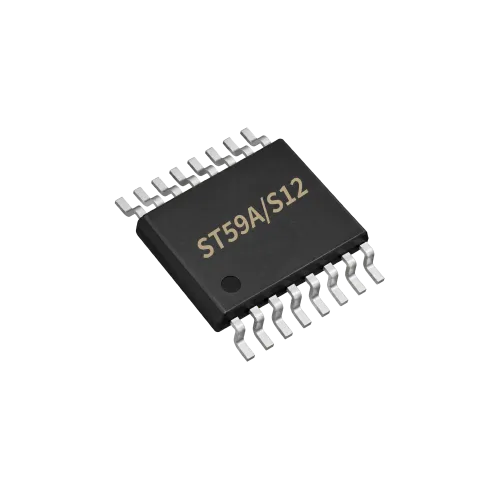
ST59A/S12 Photoelectric Smoke Detector Control IC, 8µA Low Power
Specifications
Product details
Overview
The ST59A/S12 is a CMOS LSI designed for smoke detection, containing ultra-low-power analog and digital circuits. Combined with an IR photoelectric chamber, the IC detects smoke by receiving light scattered by tiny smoke particles entering the chamber; when smoke is detected, a burst of alarm sounds is generated by an external piezoelectric buzzer driven by the IC's push-pull outputs. The variable-gain photoelectric amplifier connects directly to the IR photodiode, with gain set by external capacitors C1 and C2: minimum in standby, medium under smoke conditions, and maximum in test mode or during chamber-sensitivity supervision. LED flashing combined with alarm sound indicates a LOCAL SMOKE condition, while pulsating alarm sound alone indicates a REMOTE SMOKE condition. Housed in an SOP-16 package, the ST59A/S12 provides a complete low-power control solution for battery-powered photoelectric smoke detection systems.
Features
- 6V~12V power supply range
- Average standby current of only 8µA — ideal for battery-powered applications
- Photoelectric detection: IRED pulses drive an external NPN and IR photodiode
- BRASS/SILVER push-pull outputs directly drive a piezoelectric buzzer
- Low-supply detection with 6.5~7.8V alarm threshold (VIN=VDD/3)
- I/O pin interconnects up to 40 detectors for auxiliary/remote alarm and auto-dialer
- TEST pin for simulated-smoke testing, automatic chamber-sensitivity supervision
- Open-drain LED output drives a status indicator directly
- -10~+60℃ operating temperature, SOP-16 package
Typical Applications
- Photoelectric smoke detection and alarm systems
- Battery-powered standalone smoke alarms
- Interconnected smoke detector networks (auxiliary/remote alarm, auto-dialer)