

Low-Dropout Regulator (LDO) Selection: Ultra-Low-Power to 1A Output
Why "How to Choose an LDO" Matters More Than "Whether One Exists"
Price increases plus a domestic substitution window make selection skill a cost advantage. Since 2026, power management ICs have become the focus of price hikes, while automotive inventory correction is ending and electrification is driving demand back up. For power engineers, the LDO is on almost every board — and the most casually mis-selected part.
This guide lays out all 10 STST LDO part numbers, from 1 µA quiescent current to 1 A output, mapped to real scenarios. All parameters are transcribed from official datasheets; unspecified items are marked "—".
Why LDOs Still Win: Three Solid Reasons
- Lower noise: no switching action means clean output for ripple-sensitive loads such as ADCs, sensors, and RF front-ends.
- Lower cost, simpler periphery: a few capacitors suffice — no inductor, no loop compensation, leaner BOM and faster layout.
- Standby power is hard currency: in always-on IoT devices, microamp-level quiescent current directly determines battery life.
In short: "high efficiency" is not always the right answer. At light loads, the LDO’s light-load advantage, low noise, and minimal periphery are things a DC-DC cannot trade for. Family highlights: ST8064 draws 1 µA IQ; the ST8568 delivers 70 dB PSRR; the ST1117 outputs 1 A; the ST78L05D withstands 42 V input.
STST LDO Family: Full Parameter Table
| P/N | Vin Range | Vout | Quiescent Current IQ | Max Output Current | Key Advantages / Protection | Package |
|---|---|---|---|---|---|---|
| ST1117 | Max 18 V | Fixed 1.2–12 V / Adj. 1.25–12 V | 2 mA (standby) | 1 A | Bipolar; fixed + adjustable versions; thermal shutdown, current limit | SOT223, TO252-2 |
| ST78L05D | 7–20 V (Max 42 V) | 5 V | 3 mA typ. | 100 mA | Classic bipolar 3-terminal regulator; strong withstand & surge immunity; thermal overload protection; PSRR 60 dB at 120 Hz | SOT89-3L, TO-92, SOP8 |
| ST8061 | 2–16 V | 1.1–5.0 V (0.1 V steps) | 2.0 µA typ. | 250 mA | 210 mV dropout at 100 mA; current limit + foldback short-circuit protection | SOT-23-3/5, SOT-89-3 |
| ST8064 | 1.5–8 V | 1.1–5.5 V (0.1 V steps) | 1.0 µA typ. | 200 mA | Lowest IQ in the family; 210 mV dropout at 100 mA; output current limit | SOT-23-3, TSOT-23, SOT-23-5, SOT-89-3 |
| ST8078 | 3–40 V | 1.2–5.0 V (higher customizable) | 2.5 µA typ. | 150 mA | 40 V high-voltage input; 400 mV dropout at 100 mA; foldback + thermal protection | SOT-89-3 |
| ST8207 | 2–6.5 V | 1.8/3.3/5.0 V | 82 µA operating / 0.1 µA shutdown | 800 mA | High-current CMOS; 100 mV dropout at 300 mA; ±1% accuracy; PSRR 65 dB at 1 kHz; ON/OFF control | SOT-89-5, SOT-23-5, TO252-5, SOT-89-3 |
| ST8208 | Up to 18 V | 3.0–5.0 V (2.1 V optional) | 3 µA typ. | 150 mA | High-voltage input with ultra-low IQ; internal feedback resistors, minimal periphery | SOT23-3, SOT89-3, TO92 |
| ST8222 | 2.8–18 V | 0.8–5.0 V (resistor adjustable) | 45 µA (standby) | 400 mA | Adjustable high-speed low noise; current limit / short-circuit / thermal shutdown; CE shutdown | SOT23-5 |
| ST8568 | 2.0–6 V | 1.0–4.5 V (0.1 V steps) | 35 µA typ. / 0.1 µA shutdown | 500 mA | PSRR 70 dB at 1 kHz; low noise 47 µVrms (10 Hz–100 kHz); output discharge | SOT-23-3/5, SC-70-5, DFN1x1-4 |
| ST9153 | 4.75–40 V | 1.8/3.3/3.6/5.0–10 V | 6 µA typ. (VIN = 7 V) | 100 mA (500 mA peak limit) | 40 V input Bi-CMOS; 300 mV dropout at 100 mA; over-current / over-temperature protection | SOT-89-3L |
Note: IQ is the quiescent current with the LDO enabled and no load; the "0.1 µA (shutdown)" figure is the residual current after CE/EN is pulled low — the two are different concepts. Always refer to the latest official datasheets.
Scenario-Based Selection at a Glance
| Application | Circuit Type | Vin Range | Typical Current | Key Requirement | Recommended STST P/N |
|---|---|---|---|---|---|
| Wearables / IoT / smart locks / TWS | Ultra-low-power LDO | 1.5–16 V | 150–250 mA | Microamp IQ for standby life | ST8064 / ST8061 / ST8208 |
| Digital cores / comm modules / multi-rail | High-current LDO | 2–18 V | 0.8–1 A | High current + low dropout + accuracy | ST1117 / ST8207 |
| Automotive aux / industrial / power tools | High-voltage LDO / 3-terminal | Up to 40–42 V | 100–150 mA | Input withstand + surge immunity | ST8078 / ST9153 / ST78L05D |
| RF front-end / ADC / AI sensing / audio | High-PSRR low-noise LDO | 2–18 V | 400–500 mA | Ripple rejection + low noise | ST8568 / ST8207 / ST8222 |
1. Ultra-Low-Power Standby: Extending Battery Life
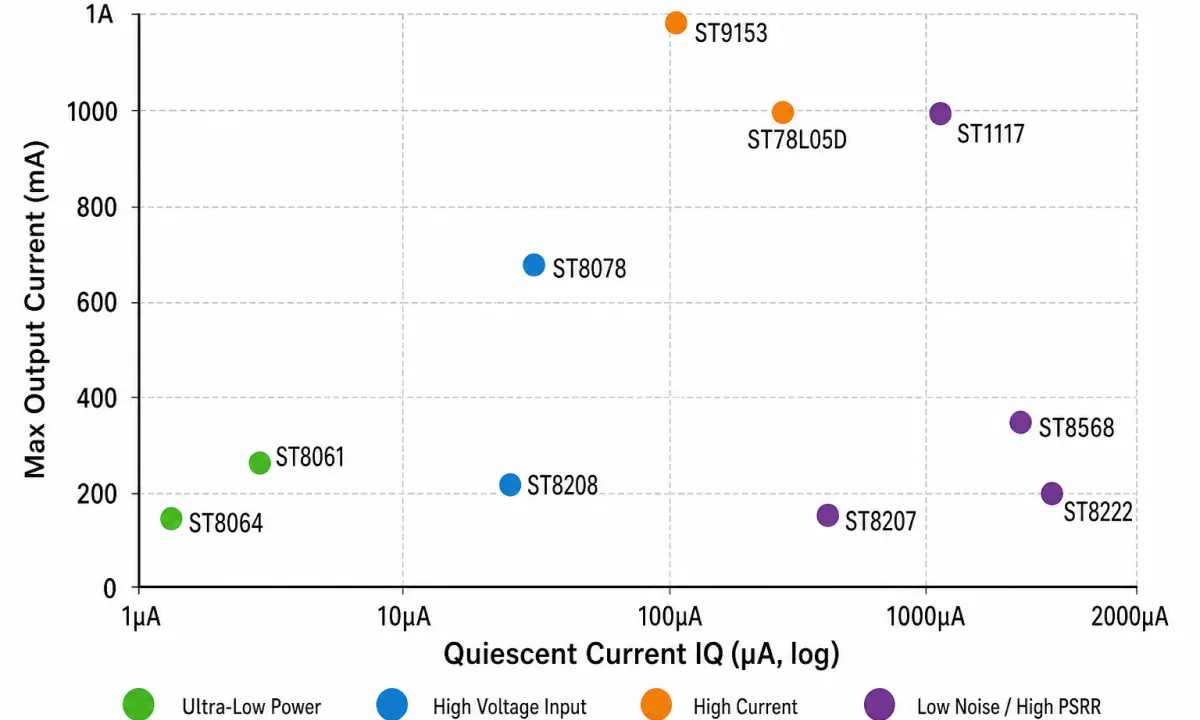
Conclusion: for devices that sleep most of the time, push IQ into the microamp range first. The ST8064 (1.0 µA) and ST8061 (2.0 µA) are the primary picks; when tapping a high-voltage bus, the ST8208 (18 V) or ST8078 (40 V) combine withstand with low power.
2. High-Current Rails: Supporting Board-Level Loads
Conclusion: choose the ST1117 for raw current, the ST8207 when dropout matters. The ST1117 delivers 1 A in fixed and adjustable versions with comfortable thermal margin in SOT223/TO252; the ST8207 covers efficiency-sensitive rails with 800 mA, 100 mV dropout, and ±1% accuracy.
3. High / Wide Input Voltage: Surviving Automotive and Industrial Buses
Conclusion: check input withstand before anything else. Automotive 12 V/24 V and industrial buses surge well above nominal; the ST78L05D (42 V) and ST8078 / ST9153 (40 V) form the wide-voltage line while keeping quiescent current at a low 2.5–6 µA.
4. Low Noise / High PSRR: Clean Power for Analog Loads
Conclusion: ripple is noise pollution — prioritize high PSRR. The ST8568 (70 dB plus 47 µVrms) is the first choice for RF/ADC rails; for high current with ripple rejection choose the ST8207 (65 dB); for on-the-fly trimming use the adjustable high-speed ST8222.
The Selection Formula and Four Pitfalls
LDO power dissipation P = (VIN − VOUT) × IOUT; junction temperature estimate TJ = TA + P × RθJA.
Pitfall 1: Do Not Stare at Accuracy — Do the Thermal Math First
- Higher dropout × current means more on-chip dissipation; at high dropout and high current, consider a DC-DC first.
- With a wide input span (e.g., 40 V to 5 V), dissipation matters even at low current — check package thermal capability.
Pitfall 2: Distinguish Quiescent Current (IQ) from Shutdown Current
- IQ determines always-on standby drain; shutdown current is the residue after EN is pulled low (as low as 0.1 µA on some parts).
- Use low IQ for always-responsive loads and EN shutdown for loads that can sleep completely.
Pitfall 3: High PSRR Is Not a Universal Filter
- PSRR rolls off with frequency — check data at your target band, not a single headline figure.
- Low noise combined with high PSRR is what gives AI sensing loads a truly clean rail.
Pitfall 4: Do Not Overlook Packages and Customization
- Many voltages support 0.1 V-step customization (±1%), covering finer bins.
- Choose SOT-23-3 / DFN1x1-4 for compact layouts and SOT223 / TO252 for higher power dissipation.
Conclusion
Domestic substitution is about choosing right, not just having options. The STST LDO family spans 1 µA to 1 A and 3 V to 42 V, covering low-power, high-current, high-voltage, and low-noise scenarios. Sorting out the selection path now is far calmer than swapping parts under shortage pressure.
Next steps:
- Download Datasheet: get full electrical parameters and package information for each part number.
- Request Free Samples: submit part numbers and quantities online to start evaluation.
- Contact Engineering Team: one-on-one selection and replacement support from our FAE team.
FAQ
How do I choose between an LDO and a DC-DC?
Look at load current and dropout. When the dropout is small or the current is modest, an LDO wins on light-load efficiency, clean output, and minimal periphery (a few capacitors), with lower cost and no switching noise. When high dropout and high current coincide, on-chip loss (P = (VIN − VOUT) × I) becomes significant and a DC-DC (85–95% efficiency) is the better deal. A typical threshold: once VIN exceeds VOUT by about 50% (VIN/VOUT ≈ 1.5) at meaningful power, the LDO delivers only about two-thirds of the input power to the load.
What is the difference between quiescent current (IQ) and shutdown current, and which one affects standby?
IQ affects always-on standby; shutdown current affects powered-off standby. IQ is the current the LDO consumes while enabled with no load, directly determining drain in listening/sleep states — for long-standby devices such as IoT nodes, TWS earbuds, and smart locks, microamp-level IQ (e.g., the ST8064 at 1 µA) significantly extends battery life. Shutdown current is the residue after CE/EN pulls the output fully off (as low as 0.1 µA on the ST8207/ST8568). Combine both: low IQ for always-responsive loads, EN shutdown for loads that can sleep completely.
Where are high-PSRR LDOs used, and why does 70 dB matter?
PSRR (power supply rejection ratio) measures how well an LDO suppresses input ripple — the higher, the cleaner the output. Loads such as RF front-ends, ADC/DACs, and AI sensors are extremely noise-sensitive; switching ripple from an upstream DC-DC can degrade SNR and increase quantization error. The ST8568 achieves 70 dB at 1 kHz and the ST8207 65 dB, effectively isolating input ripple; combined with low noise (47 µVrms on the ST8568), they provide a clean rail for demanding analog loads.
For high input voltages (automotive/industrial buses), why are the ST8078 and ST9153 recommended?
Because input withstand is the first safety line in these scenarios. Automotive 12 V/24 V and industrial buses surge well above nominal during transients, and LDOs with insufficient ratings can fail. The ST78L05D withstands 42 V, while the ST8078 and ST9153 both accept 40 V inputs — surviving spikes first. These high-voltage parts still keep quiescent current low (2.5 µA for the ST8078, about 6 µA for the ST9153), preserving standby power when tapping high-voltage buses.
Why does the same LDO appear in several recommendation groups?
Because one LDO often satisfies several selection dimensions at once. The ST8078 belongs to both the ultra-low-power group (IQ 2.5 µA) and the high-voltage group (40 V) — a cross-over player; the ST8207 combines high current (800 mA) with high PSRR (65 dB). Grouping helps you locate candidates quickly, but the final call should follow your board’s voltage, current, thermal, and noise budgets.